
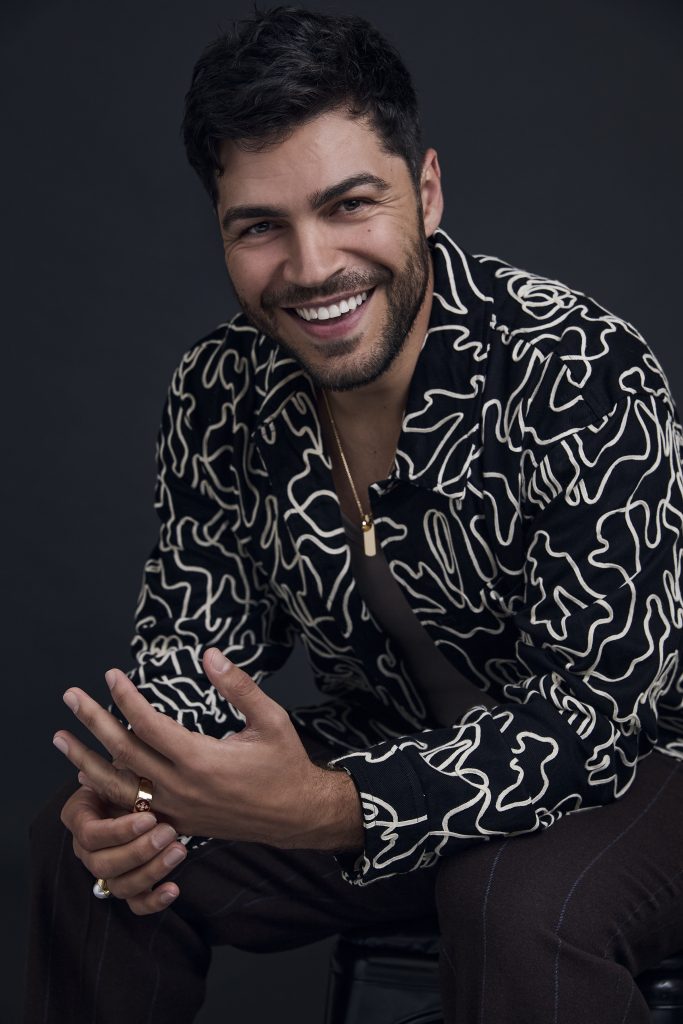
Laughter as Lifeline: How O’Neil Thomas Turns Comedy into Care
O’Neil Thomas still remembers the first time a room full of strangers applauded for him. Third grade. A Christmas show he didn’t want to be in. One tiny moment onstage with no lines, just action, just exposure.
He walked out terrified and walked off changed.
“At curtain call, I felt this warm thing in my heart,” he recalls. “I thought, I think this is what I’m supposed to do.”
A lot has happened between that elementary school stage in Paterson, New Jersey and millions of views on TikTok, between local Christmas pageants and streaming credits on The Good Cop and The Blacklist: Redemption. But the throughline—the thing that keeps showing up, no matter the format—is simple: O’Neil is in the business of healing, and his favorite instrument is laughter.
He grew up in a home where noise and love existed at the same volume: brothers, pets, a hardworking mother, stories that turned into running jokes. His voice lights up when he talks about her.
“I’m very close with my mom,” he says. “A big part of who I am is because of her and her hard work and tenacity. I’m just trying to do at least a percentage of what she’s done.”
It’s easy to see the direct line between that kind of steady, anchored love and the way he shows up for people online. There is an almost maternal softness in the way he addresses his followers—especially the ones who come to him in their lowest moments.
“For me, humor is how I heal,” he says. “And I’ve seen how it heals other people. One moment of laughter and I forget everything else for a second. I’m fully present. It’s a gift.”
For him, humor is therapy. It’s the reset button we forget exists. In a world obsessed with constant motion, he hands people a moment of intentional stillness—wrapped in chaos, delivered with perfect comedic timing. While everyone else scrolls themselves numb, he drops in with a spark of presence: a quick hit of honesty, stillness, and heart that snaps people out of the doom-spiral and into something that actually feels human.
That present-tense magic is why a throwaway Hamilton bit changed his life.
During the pandemic, like millions of others, O’Neil finally watched Hamilton when it arrived on Disney+. Then he watched it again. And again. “I was a full-blown Hamilton stan that week,” he laughs. Eventually, he made a TikTok: O’Neil doing mundane chores while belting show tunes. It went viral overnight.
“I realized TikTok is really about community,” he says. “You share something you love, and people go, ‘I feel that, too.’”
He kept going. The audience kept growing. And somewhere between the Hamilton jokes and the comedy sketches, something deeper emerged.
There’s a particular kind of courage in being the funny friend who also says, “I’m not okay.” In being willing to speak aloud the parts most people hide — the highs, the lows, the hard seasons — and in doing so, creating space for others to tell the truth too. He reminds us that being a human is not a weakness.
“I started noticing patterns in myself,” he explains. “My highs were really high, but those lows? Sometimes they got a little scary. And I thought, if I’m feeling this way and I’m Mr. Giggles, imagine how someone else might feel all the time.”
He knew, too, how mental health is often handled—or ignored—in Black communities. “It still feels taboo when it shouldn’t be,” he says. “I wanted people who look like me to feel seen.”
So he turned the camera on and told the truth. Some days, that truth looks like a perfectly crafted sketch about Beyoncé, Bruno Mars, or a deeply unbothered cat. Other days, it looks like O’Neil, speaking plainly into the lens, saying, I’m struggling today, and naming exactly why.
That kind of transparency comes at a cost, but it also comes with rare rewards. One of them arrived recently in a Boston hotel room, late at night, when the work day was over and his guard was down.
“I got a DM from a woman who said she and her daughter are both autistic and they love my videos,” he says. “She sent a video of her daughter dancing to one of my episodes. And then she wrote the most beautiful thank-you. I just sobbed.”
It’s easy to forget, when you’re filming alone in a room, that your words echo in other people’s lives. Messages like that make it impossible to forget. “It was the reminder I needed,” he says. “Get out of your head. What you’re doing matters.”
If there’s a secret as to why people connect with him, it might be this: he never forgets to live his life. He moves through the world with his eyes, ears and heart open collecting all the small, messy, beautiful, joyful, chaotic, and weird pieces of humanity. He pours all of this into his work. It’s not all imagination, but observations of the real world that make the lasting impact. As he says, “It’s about humanity. You need things to pull from. You need heartbreaks, weird jobs, awkward parties, random friendships, mistakes. You need time where you’re not thinking about a camera or a script, you’re just observing people at the park, listening to conversations at a café, being in the world.”
“Acting is about life,” he says. “You can make acting your whole world and miss out on the experiences you need to portray it honestly. You have to live. Make mistakes, go to parties, sit in the park and just watch people. Ninety-nine percent of the time, when you get a script, it’s based on something that actually happened.”
He takes that responsibility seriously, both as an actor and as a writer. Ask him what true representation means and he doesn’t give a buzzword answer. He talks about specificity.
“Representation is about truth,” he says. “You can tell when a teen drama was written by someone who’s never been a teenager. You can’t create one character and expect them to speak for millions of people. If a character feels a little too specific, you’re probably doing it right. We’re all multifaceted. Let the characters be that, too.”
It’s the same attention to detail that shaped him at Rosa L. Parks School of Fine and Performing Arts, where he spent so much time in the theater that it may as well have been his homeroom. It’s what won him first place in a national dramatic competition as a freshman, in a scene so intense his partner asked him—intentionally—to really slap her at the climax. And it’s what drives his current dream project: a music-driven, choreography-rich story set on a college campus, where comedy and drama exist in equal measure and nobody has to flatten themselves to fit into a trope.
“I’ve always loved big musical numbers with real emotional stakes,” he says. “I want something that feels otherworldly and still incredibly relatable.”
Relatable might be the key word with him. Whether he’s analyzing seasonal depression, confessing to thousands of TikTok drafts across three phones, or talking about his comfort show (Family Guy), there’s no distance, no pedestal.
“As creators, we’re our own harshest critics,” he admits. “We can give a groundbreaking performance and still think, I could’ve done that better.” That’s why he keeps his gratitude loud—especially for the people who saw him clearly before the world did. He speaks about his theater teacher, Tiffany Wilson, with the same reverence he gives Beyoncé and Hamilton. She was the first to tell him, “You have something special,” and mean it so consistently that he started to believe her.
Belief, as it turns out, is contagious.
He sees it now in the kids and teens who find him online, in the quiet DMs from people on the edge, in the way his audience talks back to him in the comments: I feel this. I needed this. I thought I was the only one.
“You have to remind yourself your voice is your power,” he says. “Not the version of you that tries to sound like someone else. You.”
That’s the real thesis of O’Neil Thomas: not that he makes people laugh—though he does, loudly, often—but that he keeps telling them, in different forms, that who they are is already enough. That their experiences are valid. That their quirks, awkwardness, and softness are not flaws to sand down but raw material to build a life from.
“I wasn’t always confident,” he says. “I used to really dislike the person I saw in the mirror. In college, I started realizing, Oh, I’m not as bad as I think. I might actually be kinda cool. Once I walked in that, all the right people started to come into my life, and the wrong ones left.”
Ask him what’s cool about America and he doesn’t hesitate: the collective insistence on individuality. Ask him what’s cool about himself and he answers with disarming honesty: his commitment to being exactly who he is, quirks and all.
That’s the paradox of O’Neil Thomas. On paper, he’s a comedian, an actor, a content creator. In practice, he’s something quieter and more radical: a reminder that in a world obsessed with image, impact is still the thing that matters most. That laughter can be a lifeline. That mental health deserves a microphone. That your story—messy, specific, imperfect—might be exactly what someone else needs to hear to feel less alone.
There are talented people, and then there are deserving people — the ones who pour their whole soul into what they do, who lift others even while carrying their own weight. He is both. He’s the kind of person who earns every good thing that finds him. The kind of person whose success feels inevitable, because it’s built on heart.
Leave a Reply